

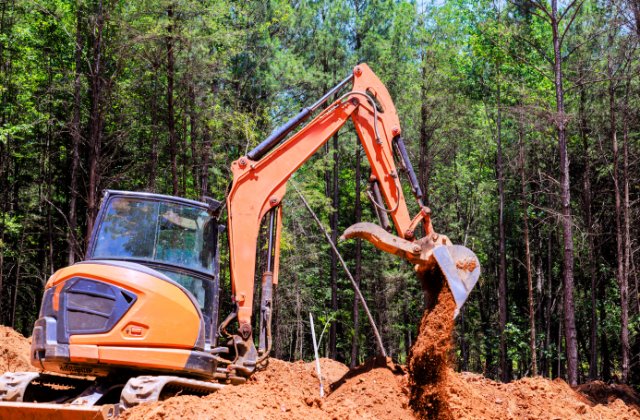
People who enjoy hands-on tasks, mechanical systems, and problem-solving may have an interest in careers that involve operating heavy machinery.
These active environments require ample attention to detail and spatial awareness as well as technical skills.
If you’re intrigued by this role but aren’t sure which industries support your interests, exploring the trades that involve operating heavy machinery is a good starting point.
1. Construction
Construction crews rely on operators during site preparation, road building, utility installation, and large building projects. Each decision affects the next stage of work because grade and placement influence drainage and access. Operators in this field move soil, grade surfaces, lift materials, and prepare stable work areas.
Training typically includes learning how to operate equipment—such as excavators, bulldozers, and backhoes—while understanding site plans and measurements. Over time, operators can build experience that leads to specialized roles or opportunities to work on more complex projects.
2. Mining
Mining careers place operators in demanding environments where large machines move rock and support production. Workers might run loaders or haul trucks during underground and surface operations. The setting requires patience because tight spaces and heavy loads leave little room for rushed decisions.
Training connects machine control with safety habits and equipment awareness. You will have a comprehensive understanding of the functions of off-highway driveline components as well as the way torque moves through heavy machines during demanding cycles.
3. Agricultural
Agricultural trades rely on heavy machinery during planting and harvest seasons. Operators guide machines across fields where soil and crop conditions shape each pass. Their work supports food production through timing and careful equipment handling.
This trade connects mechanical skill with land management and seasonal knowledge. The farming schedule changes throughout the year, so operators learn how machinery serves each season. During the fall, combines harvest the crops efficiently. In the winter, equipment like loaders may be used for maintenance and storage tasks.
4. Forestry
Forestry trades use heavy machinery in rugged outdoor settings. Operators commonly work with feller bunchers, skidders, and harvesters to cut, gather, and transport timber. These machines handle uneven terrain and dense forest conditions.
Additional machines, such as forwarders and log loaders, help move and organize timber after cutting it. Overall, it’s essential to have precise control and coordination to operate the various types of forestry equipment.
5. Transportation
Transportation trades center on moving freight through rail yards, ports, and distribution hubs using specialized heavy equipment. From stackers to container handlers to rail-mounted cranes, operators will lift, stack, and position cargo. They load intermodal containers onto railcars, shift trailers between docks, and organize freight in tight yard layouts.
Operators will follow detailed loading plans and coordinate movements to keep freight flowing without delays. In particular, this trade demands steady focus and strong spatial awareness as operators guide heavy loads through confined spaces.
Find Your Preferred Career
Whether a career in mining or transportation piques your interest, there’s a trade that will suit your interest in operating heavy machinery. Each industry offers a unique setting and skill set. With this information, you can choose the right career path.
Image Credentials: By ungvar, File #2073425097
end of post … please share it!
| envato.com |
private student loans: when you need a little extra to pay for college


Comments